

Stochastic SEIR Model with Two Infectious Classes Under Environmental Variability: Well-Posedness, Extinction Persistence Thresholds, and Milstein Based 3D Simulations
DOI:
https://doi.org/10.37256/cm.6620258833Keywords:
stochastic epidemic models, Susceptible-Exposed-Infectious-Recovered (SEIR), reproduction number, extinction, persistence, Milstein schemeAbstract
We study a stochastic Susceptible-Exposed-Infectious-Recovered (SEIR) model with two infectious classes that capture behavioral heterogeneity: a primary (lower-compliance) class Iu and a secondary (higher-compliance) class Iu reached at rate σ. Transmission follows saturated incidence, and environmental variability is modeled by multiplicative mortality noise: a shared Brownian perturbation acting on S, E, R (intensitiesηS, ηE, ηR) and an independent perturbation acting on Iv (intensity ηV ). We establish global existence, uniqueness, and positivity of solutions, and derive a noiseadjusted reproduction quantity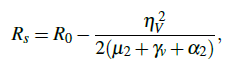 which provides a sufficient threshold: if Rs <1 the infection becomes extinct almost surely, whereas if Rs >1 the infection persists in the time-average sense. Milstein-based simulations using the same stochastic dynamics corroborate the analysis: subcritical regimes yield rapid fade-out, while supercritical regimes sustain transmission with substantial variability in peak size, timing, and time to extinction. Overall, randomness and compliance-driven heterogeneity materially reshape outbreak risk and should be accounted for when assessing control strategies near the threshold.
Downloads
Published
How to Cite
Issue
Section
License
Copyright (c) 2025 Shah Hussain, Asma Khalid, Saira Javed, Ilyas Khan

This work is licensed under a Creative Commons Attribution 4.0 International License.